
Dr Anandaroop Ray
Mr Tim Scarr
Dr Anandaroop Ray
Geoscience Australia, Symonston, Australia
Mr Tim Scarr
Geoscience Australia, Symonston, Australia
Overview
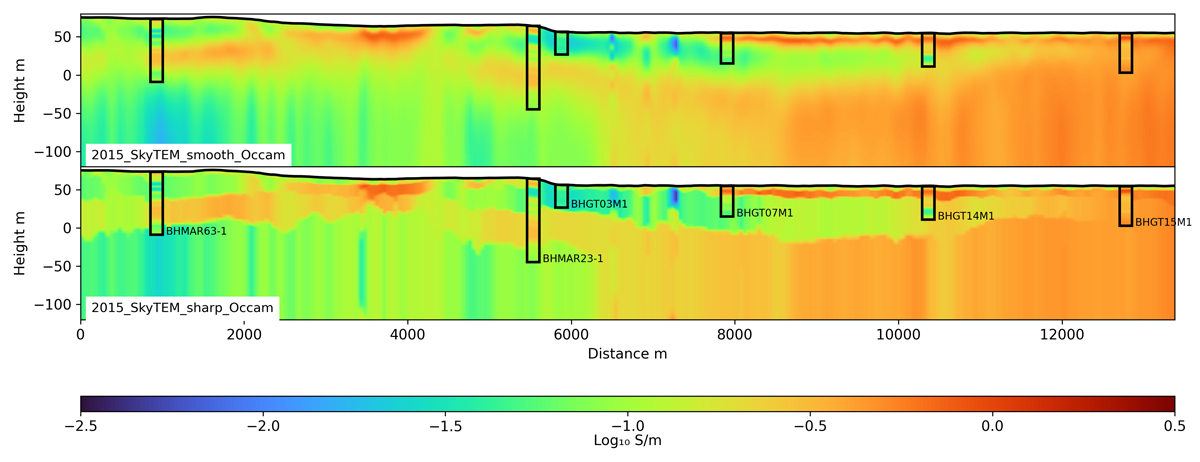
Airborne electromagnetic (AEM) surveying is a vital near-surface imaging tool for explorationists and hydrogeologists in a wide variety of minerals, energy and groundwater settings. Workhorse imaging tools use some form of deterministic inversion to convert the received AEM signal into a model of electrical conductivity with depth. Robust tools such as GA-AEM use Occam’s inversion, with explicit model smoothing based on the standard L2 norm. We have extended the original Occam’s inversion algorithm with model smoothing based on the L1 norm. Consequently, conductivity imaging with L1 smoothing produces sharp boundaries compared to traditional L2 smoothing. Not to be confused with “blocky” or minimally parameterised inversion, L1 model norm inversion can aid geoscientists with making sharp and geologically realistic interpretations.
In this half-day workshop, after a brief introduction, we will contrast L2 and L1 Occam’s inversion with browser-based, cloud-hosted notebook exercises using the HiQGA codebase. Exercises will use synthetics as well as real data from the Menindee Test range. Participants need only bring an internet enabled laptop and their enthusiasm to engage in discussion.
What are the learning outcomes?
Participants will understand the difference between smooth and sharp inversion, as well as how to perform these using the HiQGA codebase.
Who should attend?
Those interested in near surface exploration or groundwater systems using airborne methods.